

(This post was originally issued to paid subscribers in October 2025)
Victoria’s long reign saw enormous invention and innovation. It is a fascinating period of history - my favourite one of all, and much of the reason for that is the photographs we have of people and places that help bring them to life. When the new Queen took the throne in 1837 it was at the very beginning of photographic history, but by the time of her death in 1901 we had moving film - both of which must have been extraordinary developments when seen for the first time. Appropriately it was Victoria’s first and only visit to Sheffield that provides the earliest known film of the city. The sovereign’s visit to open the new Town Hall in May 1897 was witnessed by many thousands of Sheffielders, and widely photographed as we would expect - but was also the beginning of a long history of films featuring the city.
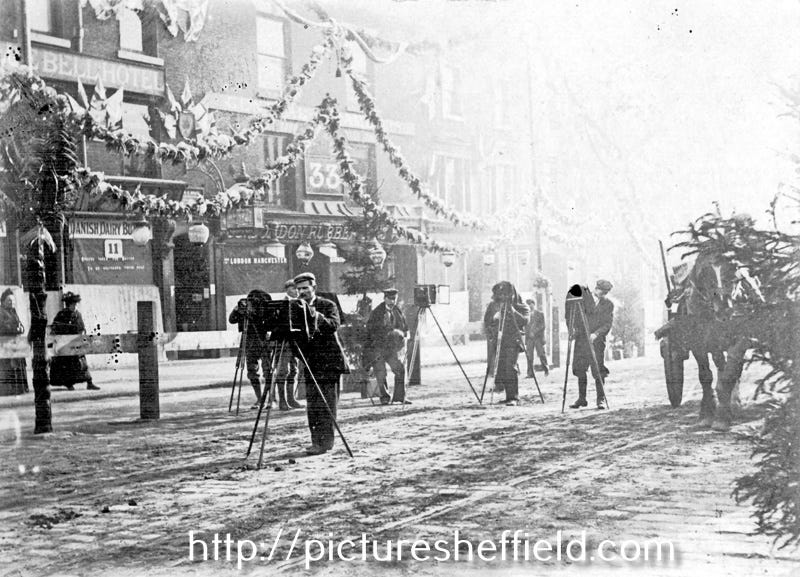
Photographers wait on High Street for Victoria’s visit, May 21st 1897.
In amongst the spectators and photographers that day were Sheffield’s first film-makers, however they had come from elsewhere. The makers of that historic footage were Riley Brothers of Bradford, so it appears that no-one was equipped to do so in Sheffield. Interestingly the only older piece of film held by the Yorkshire Film Archive (YFA) is a Bradford street scene, although it is not known who took that - the fact that there is a list of possibilities puts Bradford at the centre of the very earliest film-making in the region. One of the companies taking photographs on the day was the Sheffield Photo Company, owned by Frank Mottershaw, who later wrote that he was positioned in the spectator stands outside the Town Hall. Mottershaw went on to play a vital role in making Sheffield an important early centre of film-making.
https://player.bfi.org.uk/free/film/watch-the-queen-at-sheffield-1897-online
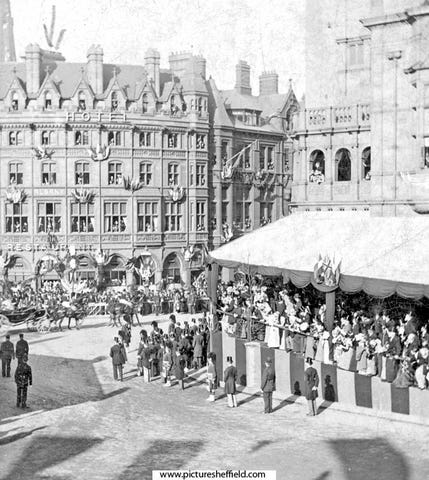
The spectator stands outside the Town Hall for Victoria’s visit
The first recorded public showing of the film in Sheffield was not until Christmas Eve 1897 at the Montgomery Hall, Surrey Street. Mottershaw’s Sheffield Photo Company also purchased a copy from one of the Bradford based exhibitors and began to show the film, leading to the pictures sometimes being mistakenly credited to Mottershaw. What does happen is that Frank Mottershaw sees the potential in film not only being used to record public events, but also to tell stories - the result being one of the first ever action movies ‘A Daring Daylight Burglary’ in 1903, which sold across the world, including in the United States where it may well have had an influence on the early film industry there. With a cast consisting of members of the Sheffield Fire Brigade, the film was shot in the Millhouses area, with the former Archer Road police station and the now lost Millhouses and Ecclesall railway station figuring prominently.
The Sheffield Photo Company went on to make over sixty short films in the next few years, some of which were filmed in the city. One of the most important was the story of a notorious Sheffield criminal in ‘The Life of Charles Peace’ - a film which is unfortunately now lost. Mottershaw’s reputation also saw his company employed to film newsworthy events in the city too, such as the opening of the University of Sheffield by King Edward and Queen Alexandra in 1905. The previous year the company had even been invited to film the coronation of King Peter of Serbia - so a photo company established here in Sheffield had quickly gained an international reputation for making both fiction and non-fiction movies.
https://player.bfi.org.uk/free/film/watch-king-edward-vii-opens-sheffield-university-1905-online
I have posted previously about Mitchell and Kenyon who filmed countless street scenes mostly around Lancashire and Yorkshire. They took films which contained as many people as possible, and then sold tickets for those people to watch themselves and their friends. The Sheffield film that I looked at was a tram ride through the city in 1902, and Mitchell and Kenyon shot a few films here around that time. One interesting and different film of theirs is one that shows the aftermath of a street accident at the top of Angel Street, close to the present day Bankers Draft pub. The film is apparently of a genuine incident that they had stumbled across going about their business - the pair had earlier specialised in re-creating news events, but by this time they were concentrating on making films of real-life scenes.
https://player.bfi.org.uk/free/film/watch-sheffield-street-accident-1902-1902-online
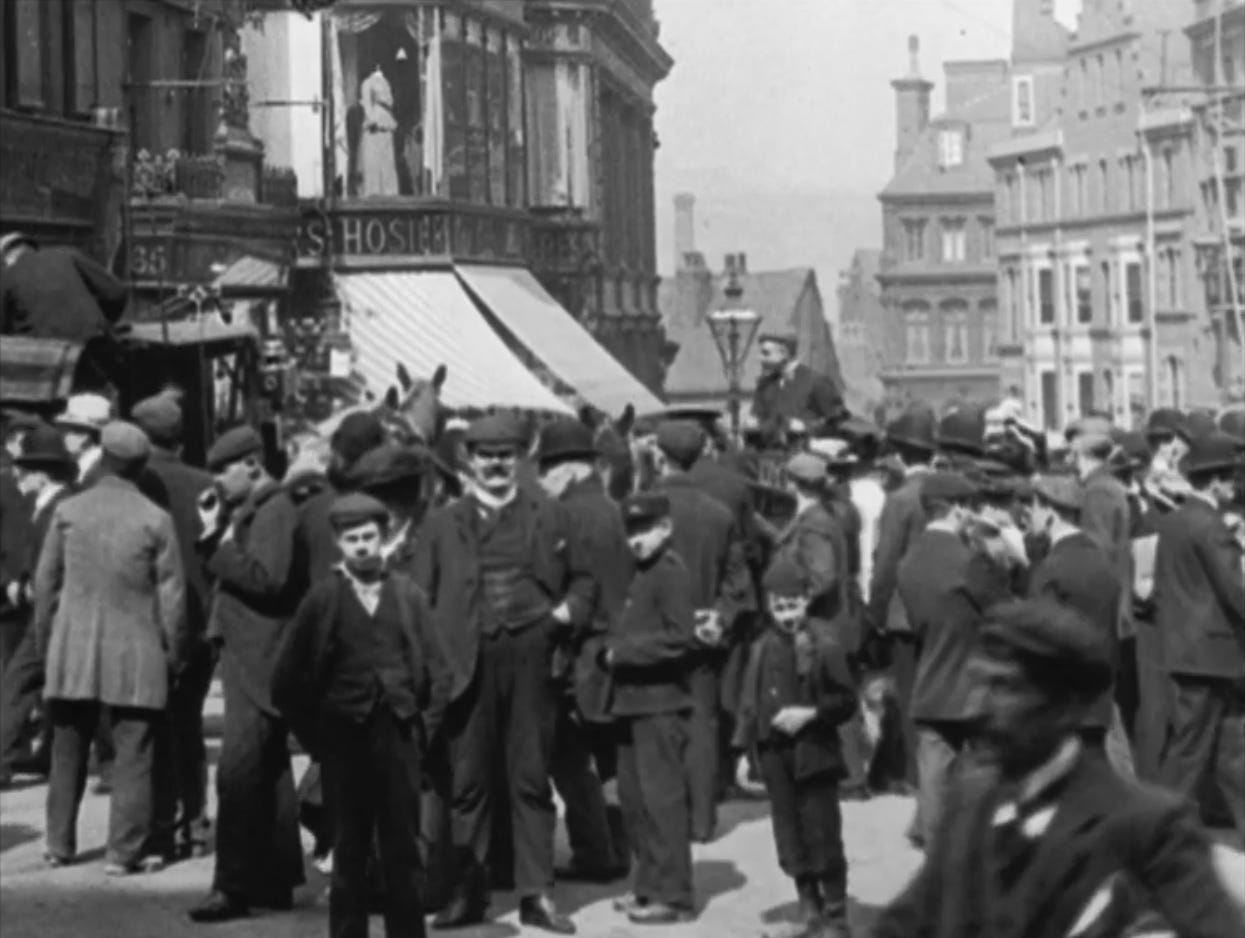
Mitchell and Kenyon being watched by the crowd at the top of Angel Street, 1902
The British Film Institute (BFI) collection includes two far more typical Mitchell and Kenyon films of Sheffield - two with a very similar set-up, but showing up great class differences of the time. In 1901 they filmed an exuberant looking workforce leaving Brown Atlas Works in Brightside, a film which ends with a crowd of equally excited children - possibly children of the men shown? The following year they filmed the congregation leaving St Peter’s Church, the present day Cathedral, and the difference is marked; very prim and proper, or possibly as Victoria is often quoted, they ‘were not amused’ by the presence of the cameras. Mitchell and Kenyon certainly preferred the more working class scenes at the factory gates - it was a common theme in their films.
https://player.bfi.org.uk/free/film/watch-employees-leaving-browns-atlas-works-sheffield-1901-1901-online
https://player.bfi.org.uk/free/film/watch-congregation-leaving-parish-church-sheffield-1902-1902-online
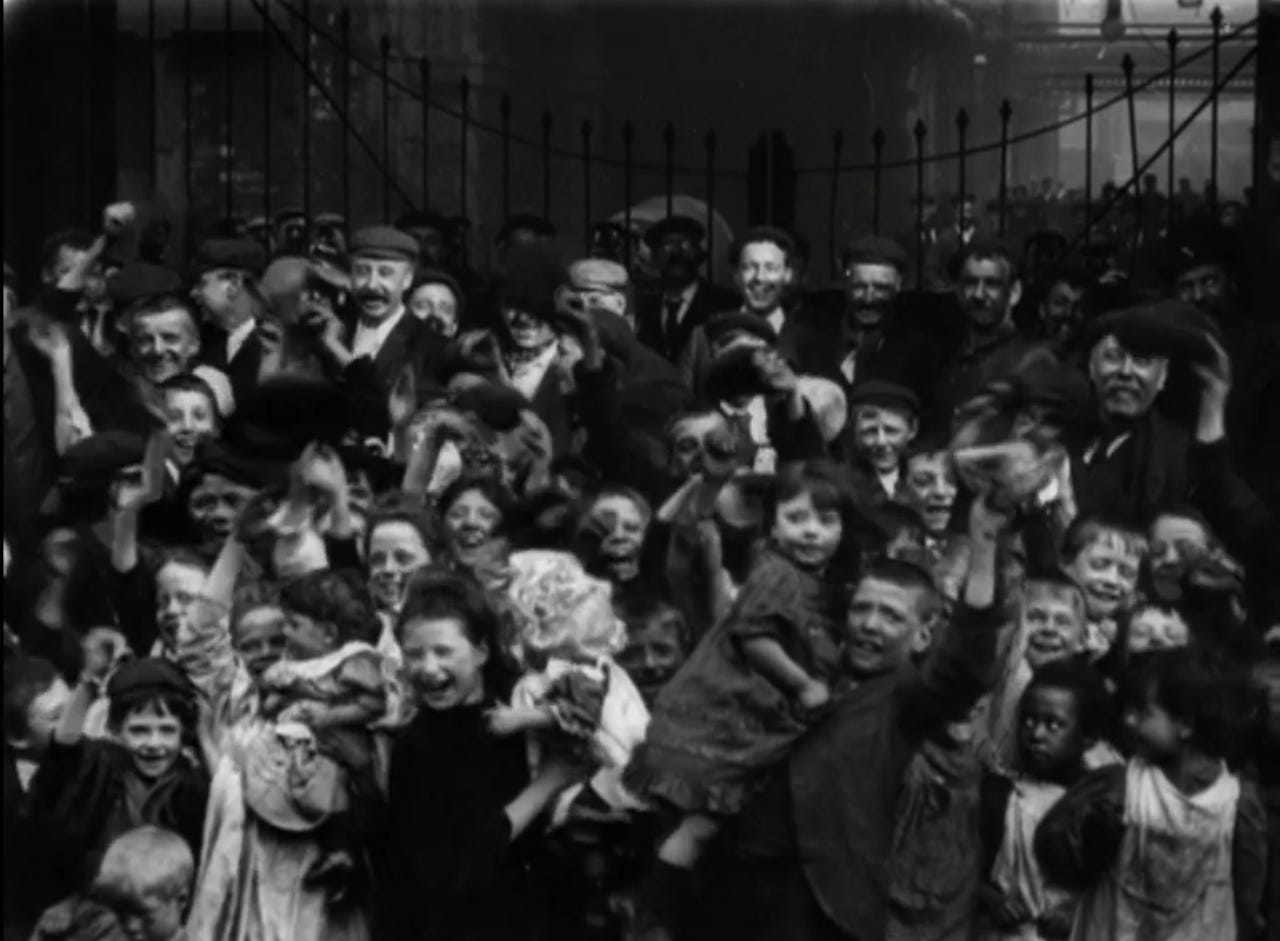
Children outside Brown Atlas Works filmed by Mitchell and Kenyon in 1901
Other films from the Edwardian era include early footage of our football teams, especially the Sheffield United team that reached the FA Cup Final in 1901 and 1902. Mitchell and Kenyon shot some of the earliest football films in this country, although often focusing on the crowd and the teams running onto the field - capturing much of the action on the field was still difficult given the technology of the time. The enthusiasm for filming working class pastimes, and also for people watching themselves and their friends on film is interesting. Certainly the tactic of getting as many potential customers as possible into their films by Mitchell and Kenyon has the great benefit for us today of being able to see many ordinary Sheffielders going about their business. We don’t just have the films of the pomp and ceremony of royal visits - but a visual record of the ordinary men, women, and children of the city too.
By the time the First World War broke out in the summer of 1914 Sheffield had already seen cinemas opening across the city. Some people were used to seeing movies by then, but also film of news events too - for the first time there was footage of war, but also of the men leaving for the front too. On November 3rd 1914 the men of the Hallamshire Rifles were filmed marching through the city centre on their way to the continent. For a few minutes a long line of often smiling and laughing men make their way past crowds of well-wishers. The film is introduced with a jaunty looking ‘Au Revoir! And Good Luck’ card - many, if not most, of these men were of course never to return. Some of them may even have been amongst the smiling and laughing children from the earlier films.
https://www.yfanefa.com/record/2717
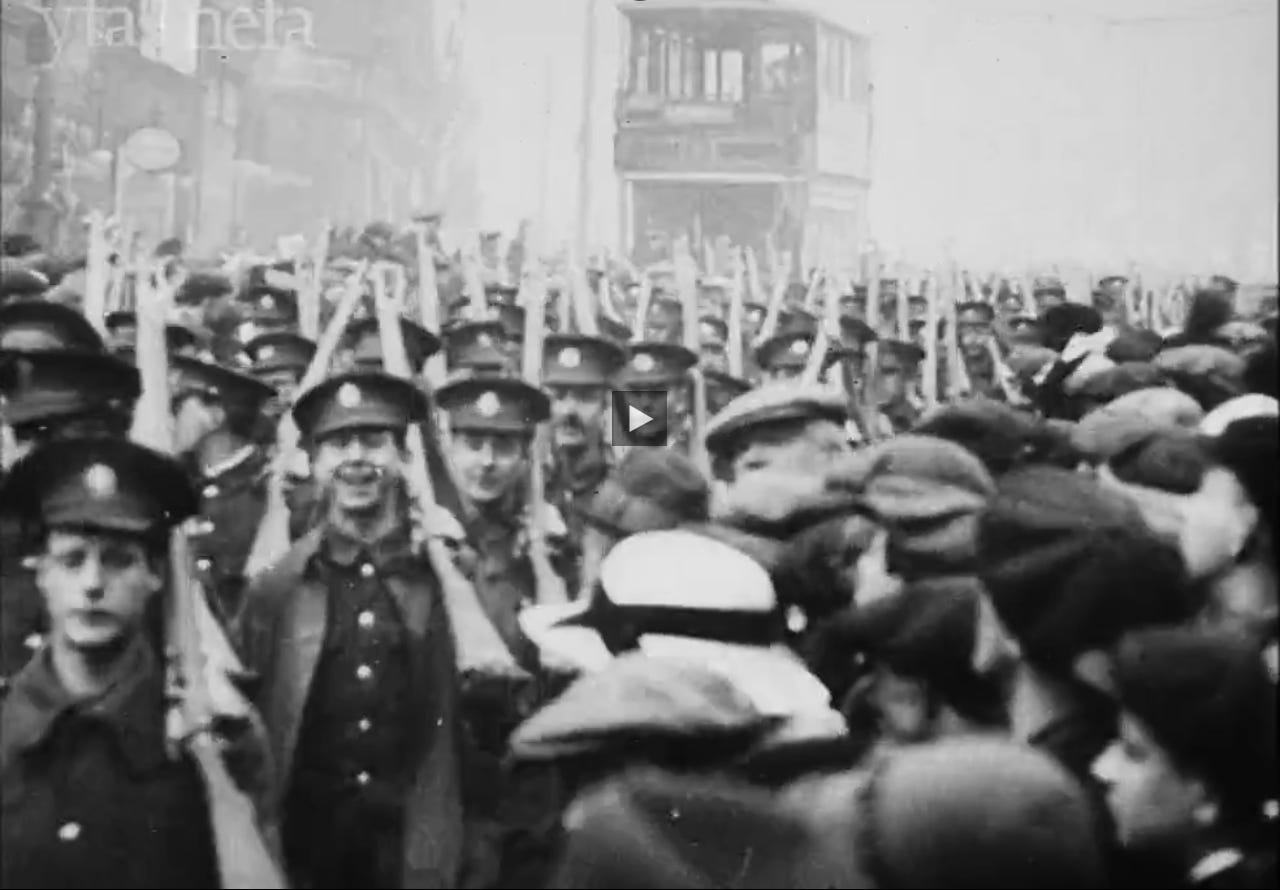
Men of the Hallamshire Rifles filmed marching through Sheffield, November 1914
In recent years many people in other parts of the country may think of ‘The Full Monty’ when they hear the name Sheffield, along with maybe our football teams or snooker at the Crucible Theatre. Film immortalises places and eras and always has - a well known film from the 1990s is already a record of the past, let alone the Edwardian faces and places recorded for posterity by Mitchell and Kenyon, or Sheffield’s own Frank Mottershaw. It is quite a thought that films made by Mottershaw and his Sheffield Photo Company sold hundreds of copies in Europe and the United States well over a century ago, showing the people and places of Sheffield to the world - at the same time cementing the city’s place in the very early days of film-making history.
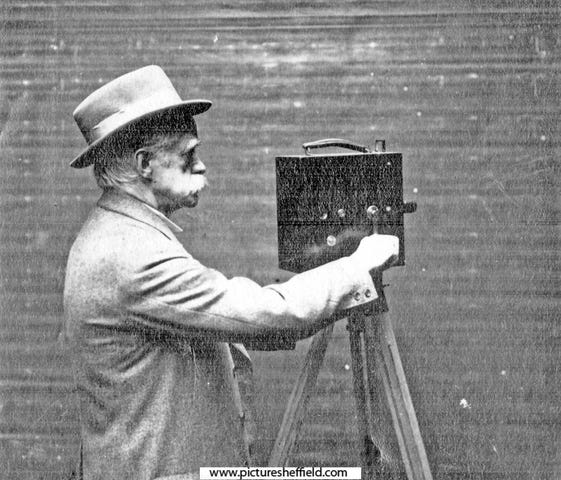
Frank Mottershaw, 1850-1932 - Sheffield born film pioneer